
What Is Unlisted Axis?
India's Pre-IPO Investment Platform — Full Explanation & Investor Guide 2026
By Kanishk Dev Bangia | NISM Series XV Certified Research Analyst
Last Updated: May 2026 | Reg. No: NISM-202300182946
India's pre-IPO market is growing faster than ever. As more retail investors realise that the biggest equity gains often happen before a company lists on the NSE or BSE, the demand for transparent access to unlisted shares has exploded. Unlisted Axis was built to serve exactly this demand — a structured, documentation-backed platform that lets ordinary investors participate in pre-IPO opportunities that were once reserved for HNIs and institutional players.
This guide explains what Unlisted Axis is, how the platform works, what you can buy, how the buying process is structured, the legal framework around unlisted shares in India, the real risks, and the tax treatment. By the end, you should have a clear picture of whether this platform fits your investment style.
(30-Second Summary)
• Unlisted Axis (unlistedaxis.com) is a dedicated pre-IPO and unlisted share platform for Indian retail investors.
• Curated access to unlisted companies across NBFCs, fintech, defence, consumer brands, and emerging sectors.
• Every transaction is backed by mandatory KYC, signed contract notes, and CDSL/NSDL holding verification — no anonymous trades.
• Minimum investment depends on the company and lot size — typically lower than traditional broker thresholds.
• Verdict: A structured, documentation-first alternative to informal WhatsApp dealers for serious pre-IPO investors.
What Is Unlisted Axis? — The Platform Explained
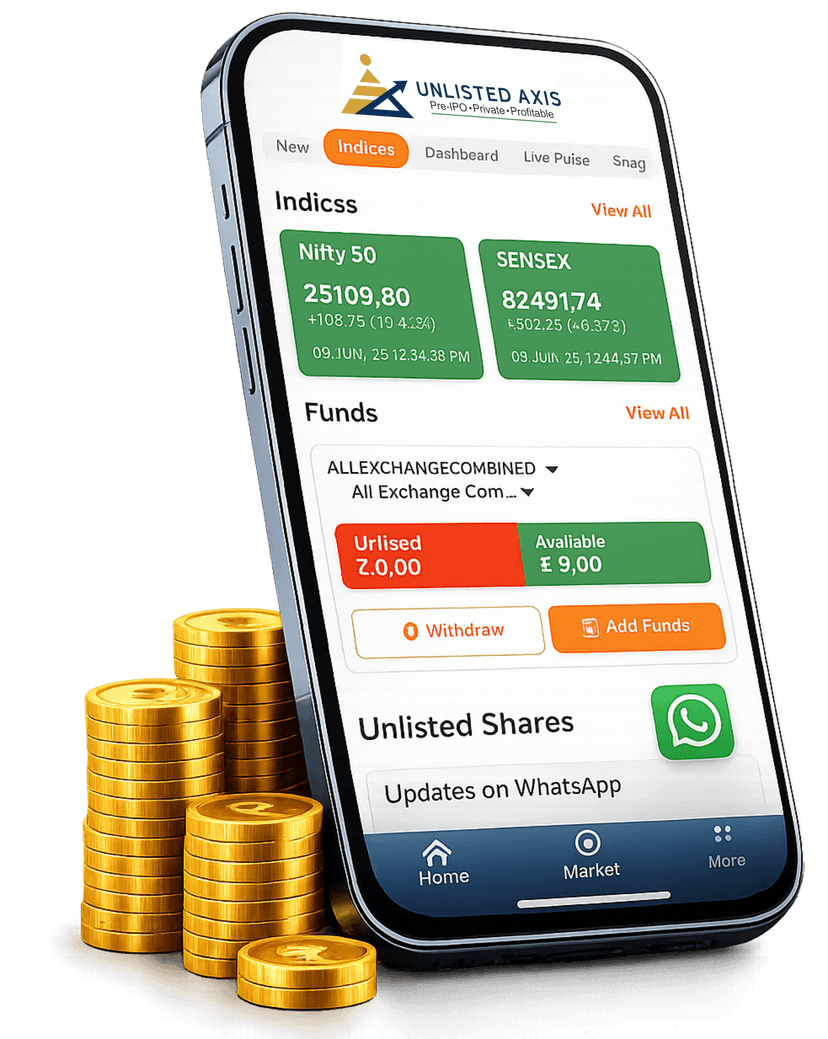
Unlisted Axis is a specialised pre-IPO investment platform built for Indian retail investors who want authenticated, systematic access to the unlisted shares market. Accessible at unlistedaxis.com, the platform offers curated portfolios of pre-IPO and established unlisted companies — businesses that are either preparing to file their DRHP or are well-established private firms not yet on the NSE or BSE.
What separates Unlisted Axis from the informal channels dominating this space — WhatsApp groups, Telegram channels — is documentation. Every single transaction on the platform comes with mandatory KYC, a signed contract note, and a holding confirmation from CDSL or NSDL. There are no verbal deals, no anonymous transfers, and no hidden counterparties.
Important: Unlisted Axis is NOT Connected to Axis Bank
Many new investors confuse Unlisted Axis with Axis Bank or its subsidiaries. To be absolutely clear: Unlisted Axis (unlistedaxis.com) is an entirely independent platform with no affiliation to Axis Bank, Axis Securities, Axis Direct, or any other Axis Group entity. Always verify the website domain (unlistedaxis.com) before initiating any payment or sharing personal details.
Why Does a Platform Like Unlisted Axis Exist? — The Market Gap
To understand why Unlisted Axis exists, you need to understand the problem it solves. The Indian unlisted share market is a large informal ecosystem where thousands of pre-IPO companies are traded peer-to-peer. Historically, access to this market was restricted to a small circle:
• HNIs with personal connections to promoters or private equity networks
• Institutional investors — venture capital funds, private equity firms, family offices
• ESOP holders looking to liquidate their stock before the company goes public
Retail investors — the same people who oversubscribe IPOs by 50–100 times — had almost no entry point into the pre-IPO phase. The reasons were structural:
• No online platform listing available stocks with transparent pricing
• No process for verifying that the seller actually owned the shares being offered
• No documentation — most deals happened over phone calls and WhatsApp messages
• High minimum investment thresholds at traditional brokers that excluded smaller investors
Unlisted Axis was built to close this gap. By making KYC mandatory, requiring signed contract notes for every trade, and verifying every seller's holding through CDSL or NSDL before funds change hands, the platform brings institutional-grade process discipline to the retail investor.
Key Features of Unlisted Axis
Curated List of Unlisted Companies
Access to a hand-picked list of unlisted shares spanning NBFCs, fintech, consumer brands, defence, edtech, and other emerging sectors. The list focuses on companies that are either IPO-ready or are established private businesses with strong fundamentals.
Indicative Live Pricing
Prices are updated from the dealer network in near real-time, giving investors a transparent starting reference. Note: these are indicative dealer prices, not exchange-verified — the unlisted market does not have a central exchange.
Mandatory KYC on Every Transaction
Full KYC — PAN, Aadhaar, bank details, and demat DP ID — is mandatory before any transaction. No anonymous trades, no shortcuts.
Signed Contract Notes
Every buy and sell is backed by a signed contract note documenting the company name, ISIN, number of shares, price per share, total consideration, and settlement timeline. This is your legal proof of the transaction.
CDSL / NSDL Holding Verification
Before any buyer commits funds, the platform verifies that the seller actually holds the shares in their demat account via CDSL or NSDL depository records. This is a critical fraud-prevention step that informal WhatsApp dealers cannot offer.
Dedicated Relationship Manager
Buyers get access to a dedicated RM for pre-transaction research support and post-transaction follow-up — including help with paperwork, payment instructions, and tracking the share credit to your demat.
Transparent Cost Structure
Unlike informal dealers where costs are hidden in wide bid-ask spreads, Unlisted Axis maintains a transparent pricing structure that investors can review before transacting.
Educational Content for Investors
The platform publishes detailed investor guides on individual pre-IPO companies, sector outlooks, and how the unlisted market works — helping retail investors make informed decisions rather than blind bets.
What Companies Can You Buy on Unlisted Axis?
Unlisted Axis features curated unlisted companies across several industry verticals. The focus is on businesses that are either approaching IPO or have established themselves as strong private companies. Major sectors covered include:
NBFCs and Financial Services
This is the most actively traded segment on the platform, with strong investor interest in established NBFCs, education-focused lenders, and tech-driven financial services companies.
Technology, Fintech and Edtech
Includes pre-IPO companies in education technology, quick commerce, hospitality technology, and market infrastructure. These businesses typically combine strong revenue growth with clear paths to listing.
Consumer Brands and D2C
Consumer-facing brands across audio, energy, drone technology, and aerospace — businesses that have built recognisable retail brands but are not yet listed.
Defence and Specialised Sectors
Companies in defence manufacturing, depository services, renewable energy, and other specialised verticals where the unlisted phase still offers meaningful upside before a public listing.
📌 Important Note on Company Availability
• Companies available on Unlisted Axis change based on supply from sellers (ESOP holders, angel investors, existing shareholders)
• Not all listed companies are available for purchase at all times — availability depends on active sellers
• Always check the live platform or contact the RM team for current availability and prices
• Prices quoted are indicative from the dealer network — not exchange-verified prices
How to Buy Unlisted Shares on Unlisted Axis — Step by Step
The buying process is structured around documentation and verification at every stage. Here is the complete workflow from account setup to share credit:
Step 1: Open a Demat Account
You must have an active demat account with NSDL or CDSL. This is non-negotiable — unlisted shares can only be received into a demat account. If you already use a demat for listed shares, the same account works.
Step 2: Visit Unlisted Axis
Go to unlistedaxis.com and browse the list of available companies. The platform displays indicative prices, company overviews, and sector information. Shortlist 2–3 companies that fit your investment goals and risk profile.
Step 3: Contact the Relationship Manager
Use the platform's contact form to connect with a dedicated RM. Share the company name, intended investment amount, and your details. The RM will share current price, lot size, availability, and the full documentation checklist.
Step 4: Complete Full KYC
Submit your PAN card, Aadhaar card, cancelled cheque (for bank details), and your demat account's DP ID and Client ID. This is mandatory — no transaction proceeds without completed KYC. The RM uses your DP ID and Client ID to initiate the off-market transfer.
Step 5: CDSL / NSDL Holding Verification
Before you make any payment, Unlisted Axis verifies that the seller actually holds the shares in their demat account via CDSL or NSDL depository records. This is a critical fraud-prevention step that informal WhatsApp dealers do not provide.
Step 6: Receive and Sign the Contract Note
You receive a signed contract note detailing the company name, ISIN, number of shares, price per share, total consideration, and settlement timeline. Read carefully before signing — this document is your legal proof of the transaction.
Step 7: Transfer Funds via NEFT / RTGS
Transfer the agreed amount from your bank account to the registered bank account mentioned in the contract note. Use only NEFT or RTGS — never pay in cash or via informal UPI handles. Keep your payment receipt as proof.
Step 8: Shares Credited to Your Demat
After payment confirmation, the off-market transfer is initiated. Shares typically credit to your CDSL/NSDL demat account within 24–48 hours (T+2 working days). Verify the credit through your broker app or DP portal.
Step 9: Annual ITR Disclosure
Even without selling, you must disclose unlisted share holdings in your annual Income Tax Return (ITR-2 or ITR-3) under Part A-General and Schedule CG. This has been mandatory since FY 2018–19 per Income Tax Department guidelines.
Unlisted Axis vs Informal WhatsApp Dealers — The Real Comparison
The most common alternative to a structured platform like Unlisted Axis is the informal dealer network operating on WhatsApp and Telegram. This is where the documentation difference matters most. Here's how the two compare on the factors that decide whether your money is safe:
SEBI, RBI and the Legal Framework — How Unlisted Axis Operates Within the Law
A common question from new investors: Is Unlisted Axis SEBI-registered? Let's address this transparently.
Regulatory Position of Unlisted Axis
• Unlisted Axis operates as an intermediary/dealer for off-exchange share transfers. It is not a SEBI-registered stockbroker or investment adviser.
• The company holds valid Companies Act, 2013 registration (verifiable on mca.gov.in) and is GST-compliant.
• Off-exchange share transfers happen through the NSDL/CDSL depository system — the same depository infrastructure used for listed shares. These transactions are fully legal and trackable.
• The transactions are governed by the Companies Act 2013, SEBI Depositories and Participants Regulations, and RBI's foreign exchange rules where NRI participation is involved.
What SEBI Covers and What It Does Not
SEBI's jurisdiction includes: the underlying company being acquired (Companies Act, ICDR Regulations), the IPO process when a company files its DRHP, and the depository system (NSDL/CDSL rules).
SEBI's jurisdiction does not include: trading in unlisted shares, valuation of unlisted shares, or disputes between buyers and unlisted share dealers.
Practically, this means any dispute relating to an unlisted share transaction must be resolved through civil courts or consumer forums, not through SEBI's investor grievance mechanism. This is why having signed contract notes and a verified payment trail matters so much.
Pre-IPO Lock-in Under SEBI ICDR Regulations 2018
Under SEBI ICDR Regulations 2018, non-promoter shareholders who acquire shares within 6 months of a company's IPO listing date face a 6-month lock-in after listing. This applies regardless of which platform you used to buy the shares. Plan your entry timing accordingly if the company is close to filing its DRHP.
Risks of Investing in Unlisted Shares — What You Must Understand
Even with a structured platform like Unlisted Axis, the underlying asset class — unlisted shares — carries inherent risks that no platform can eliminate. Unlisted Axis mitigates operational and counterparty risk; it cannot mitigate market and business risk.
Liquidity risk. Unlisted shares do not trade on any exchange. Your exit depends on finding another buyer in the OTC market or waiting for the company to go public. If the IPO is delayed or cancelled, your capital can remain locked for years.
Valuation risk. OTC valuations are unverified market estimates. A company may be priced at an optimistic forward multiple. If the IPO lists below the entry price (as has happened multiple times in recent years), you book a loss on listing.
IPO failure or delay risk. Companies sometimes withdraw their DRHP filings or delay their IPO by years. SEBI approvals are valid for only 12–18 months. There is no guarantee that a pre-IPO company will actually go public on any expected timeline.
Post-listing lock-in risk. As noted above, non-promoter pre-IPO investors who acquired shares within 6 months of listing face a 6-month lock-in after the listing date. You cannot sell during this window even if the price crashes.
Counterparty risk. Since the platform is not SEBI-regulated as a broker, any disputes require legal action through civil or consumer forums. Always verify the shares are credited to your demat before transferring funds and keep complete documentation.
Information asymmetry. Retail investors rely on MCA filings (often 9–12 months old), DRHP documents (where available), and media coverage. Promoters and institutional insiders have significantly more current information than the retail investor.
Tax law amendment risk. Budget 2024 made significant changes to capital gains taxation on unlisted shares. Future budgets may make further changes that affect your post-tax returns.
Taxation on Unlisted Shares — 2026 Rules
Tax treatment applies to the underlying unlisted shares regardless of which platform you used to buy them. The platform does not change your tax liability; the holding period and your residential status do. Here's the current framework per Finance Act 2024 and the Income Tax Act 1961:
Important: Mandatory ITR disclosure of unlisted holdings applies in ITR-2 or ITR-3 (Schedule AL) every year, even if you have not sold the shares. This has been compulsory since FY 2018–19.
Is Unlisted Axis Right for You? — Investor Suitability Check
The right platform for you depends on whether pre-IPO investing fits your overall portfolio and risk profile. Unlisted Axis suits you when these conditions are met:
Unlisted Axis Is Right for You If
• You want documented, transparent access to pre-IPO opportunities rather than informal WhatsApp dealers
• You can lock in your capital for 2–5 years without needing liquidity
• You do your own due diligence — MCA filings, DRHP where available, sector analysis
• You value having a Relationship Manager guide you through documentation
• You are limiting pre-IPO exposure to 5–10% of your overall portfolio, not your entire savings
• You understand the tax obligations including annual ITR disclosure and the 12.5% LTCG rate
Reconsider If
• You need access to your capital within 12–18 months
• You are investing based on social media hype without analysing the company
• You expect guaranteed returns — no such thing exists in the unlisted market
• You are putting more than 10% of your portfolio into a single unlisted name
• You have not verified the platform's MCA and GST registrations independently
Frequently Asked Questions About Unlisted Axis
Q1. What is Unlisted Axis?
Unlisted Axis (unlistedaxis.com) is a dedicated pre-IPO and unlisted equity platform for Indian retail investors. It offers systematic, KYC-verified access to curated unlisted companies with signed contract notes and CDSL/NSDL holding verification on every transaction. The platform is entirely independent and has no affiliation with Axis Bank or any Axis Group entity.
Q2. Is Unlisted Axis SEBI-regulated?
Unlisted Axis is not a SEBI-registered stockbroker or investment adviser. It operates as an intermediary for off-market demat transfers that happen through the NSDL/CDSL depository system. The company is registered under the Companies Act 2013 and is GST-compliant. SEBI regulates the underlying companies and the IPO process, but does not regulate the trading of unlisted shares itself.
Q3. What is the minimum investment on Unlisted Axis?
The minimum investment varies by company and lot size. Unlisted Axis generally offers more accessible entry points than traditional broker desks that require ₹5 lakh or more. Lot sizes typically range from 50 to 500 shares depending on the company. Always confirm the current lot size and price with your RM before transacting.
Q4. Is it safe to buy unlisted shares through Unlisted Axis?
Unlisted Axis provides significant operational safeguards — mandatory KYC, signed contract notes, and CDSL/NSDL holding verification before payment — that informal WhatsApp dealers cannot match. However, the underlying asset class (unlisted shares) carries inherent risks including illiquidity, IPO uncertainty, and valuation risk. No platform can eliminate these. Always verify the company fundamentals independently before investing.
Q5. What happens to my shares if Unlisted Axis shuts down?
Your shares are held in your own demat account (CDSL or NSDL), not by Unlisted Axis. The platform facilitates the transaction; it does not custody your shares. If Unlisted Axis were to cease operations, your shares remain entirely safe in your demat account. This is a key advantage of the dematerialised system over old physical share certificates.
Q6. How long does it take to receive shares after payment?
Shares typically credit to your CDSL or NSDL demat account within 24–48 hours (T+2 working days) after payment confirmation. Exact timing depends on the seller's depository participant and market conditions. Confirm the expected timeline with your RM before transferring funds.
Q7. Can NRIs invest through Unlisted Axis?
NRIs can invest in Indian unlisted shares, but only through specific routes permitted under RBI's FEMA regulations — typically via NRO accounts and within sectoral caps. Tax treatment also differs from resident investors. NRIs should consult a qualified tax advisor and confirm eligibility with Unlisted Axis's RM team before proceeding.
Disclaimer
Disclaimer:
This is written for educational and informational purposes only. Nothing here constitutes investment advice or a recommendation to buy or sell securities. All data is sourced from publicly available information. Investments in securities markets are subject to market risks — please read all offer documents carefully before investing.